The Woman Who Wanted My Name in Red Ink
It was almost 11pm when a Taiwanese woman invited my husband, our two young daughters, and me to follow her into the mountains.
She said she owned a tea plantation.
What could possibly be so interesting about tea leaves in the dark?
That was my first thought. My second was that something about this invitation didn't feel right.
It happened many years ago, when our daughters, Chloe and Cherie, were just six and four years old.
My husband, Kelvin, and I had decided to take the girls on a free-and-easy holiday to Taiwan. We landed rather late, and shortly after arriving, Chloe developed a fever.
By the time we boarded the night coach from the airport to our hotel in Ximending, we were tired and eager to settle in.
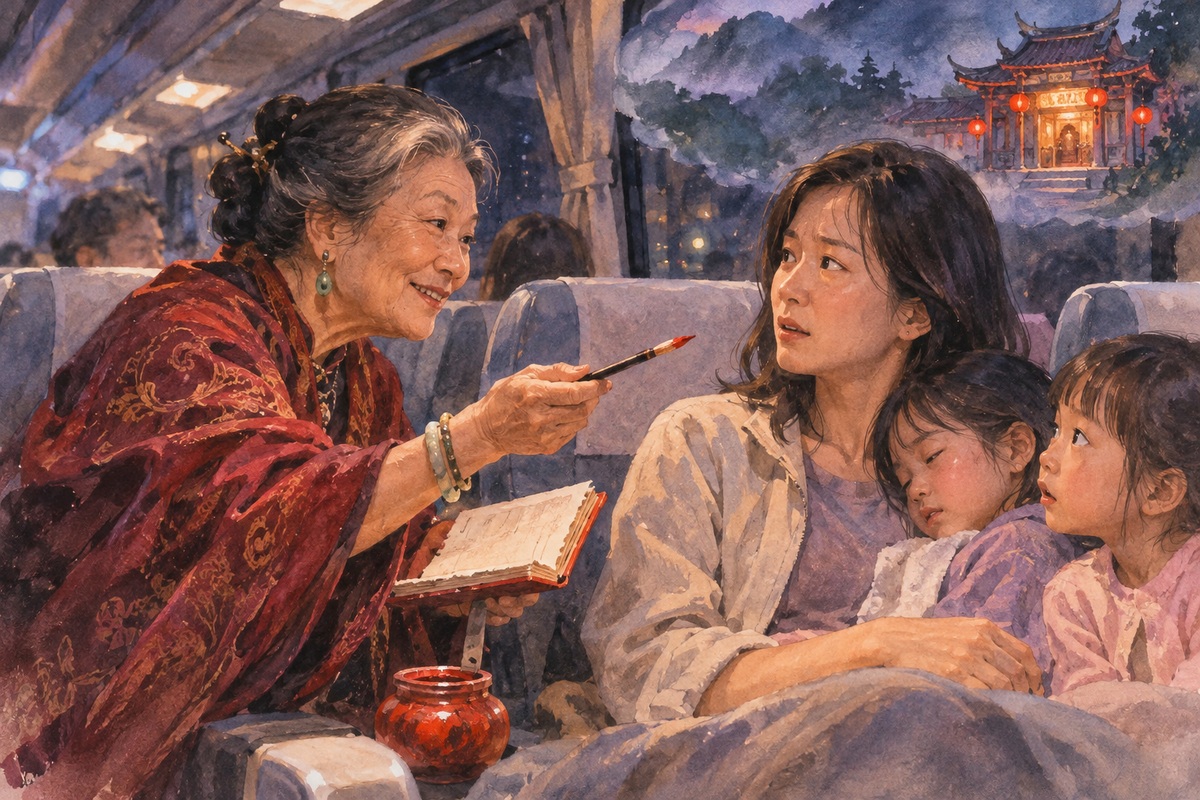
I struck up a conversation with an elderly Korean gentleman on the coach. We were chatting happily when an elderly Taiwanese woman suddenly interrupted us.
She seemed particularly interested in talking to me.
She told us she owned a tea plantation in the mountains and enthusiastically invited our family to visit.
Initially, I thought it sounded lovely. I had visited plantations in other countries before, and a Taiwanese tea plantation seemed like an interesting place to explore.
Then I realised she wasn't inviting us to visit the next morning.
She wanted us to go with her that very night.
At 11pm!
I politely declined, explaining that we had already booked a hotel and that Chloe wasn't feeling well.
But the woman wouldn't give up.
She assured us that we could spend the night at her temple. She would personally arrange transport to send us back the following morning.
Temple?
I thought we were talking about a tea plantation.
Now I was curious.
I began asking questions. What temple was this? What did she do there?
After some probing, she revealed that she was a灵媒, a spirit medium, and that her temple dealt with冥婚, or ghost marriages.
I knew a little about this old Chinese tradition. It involves arranging marriages for deceased individuals. In some forms of the practice, one party may still be alive.
Suddenly, her eagerness to bring our family to a remote mountain temple in the middle of the night felt rather unsettling.
Why was she so interested in us?
Was she looking for living people to match with deceased individuals?
Was she interested in me? Or perhaps one of my daughters?
I had no evidence that she intended anything of the sort. But once she mentioned ghost marriages, those thoughts crossed my mind.
And I certainly wasn't going to take my family into the mountains to satisfy my curiosity.
Then something even stranger happened.
Before we parted ways, the woman insisted that I write my name and telephone number in her notebook.
I took out my pen.
She refused to let me use it.
Instead, she produced a朱砂毛笔, a Chinese calligraphy brush dipped in cinnabar-red pigment.
I told her I already had a perfectly good pen.
She insisted on the brush.
I tried again.
She wouldn't budge.
What puzzled me most was that she wanted only me to write with it.
Not Kelvin. Not anyone else in the family.
Just me.
Eventually, I gave in. Under her watchful eyes, I wrote my name and telephone number in her notebook using the red brush.
She kept the notebook.
I had no idea why the colour or the writing instrument mattered so much to her. But by then, I was absolutely certain of one thing.
We were not going anywhere with this woman.
Still, I didn't want to offend her.
I cheerfully suggested that she give us her address and that we would try to visit another day.
She looked terribly disappointed.
We said goodbye and went straight to our hotel.
The encounter should have ended there.
But it didn't quite leave me.
The red cinnabar pigment had stained my hand, and the marks remained for days as we travelled around Taiwan.
Every time I looked at my hand, I remembered the woman on the coach.
Her mountain tea plantation.
Her temple.
Her ghost marriages.
And that strange insistence that I write my name in red.
Years have passed, but I still wonder what she wanted.
Perhaps she was simply an enthusiastic temple owner hoping to attract visitors. Perhaps the red brush had some significance in her religious practices.
Or perhaps there was another reason she was so determined to bring us to her temple that night.
I will never know.
Sometimes I think about what might have happened if we had accepted her invitation.
Then I remember that we had two little girls with us, one running a fever, and a hotel room waiting in Ximending.
Whatever mysteries that mountain temple held, they could remain mysteries.
Some invitations are best declined, even when the story behind them is one you would love to know.
Told by Anna Ng
Written by Sam Choo
Story Tags: Strange Encounters, Travel Experiences, Chinese Traditions
Anna Ng is a full-time real estate agent, a mother of two daughters, and an MBA graduate of Murdoch University.
Website: www.clientcentricproperty.com